


A balcony looks like the practical answer: ventilation, no smell in the living room, no floor space wasted. To a cat it can feel like the least safe place in the home. Here is what that costs — and the comparison chart worth saving to your phone.
TL;DR
- Most "behaviour problems" at the litter box start with location, not the cat.
- Four spots to avoid: the balcony, beside food bowls, next to the washing machine or a hallway, and any box with a high entry or a cramped, sealed-away interior.
- A cat will quietly hold urine rather than use a place that feels unsafe. In male cats that can become a life-threatening blockage within hours.
- The fix is a quiet, stable, indoor spot — plus a box that makes keeping it indoors liveable. We rebuilt the original vet-facing safety chart in English below, then added the design checklist we use when specifying enclosed boxes.
When the designer asked where the litter box would go, the balcony seemed obvious. The silver tabby used it on day one. Three months later he was in and out of the box constantly, squatting, producing only a few pink drops.
At the clinic the vet felt a hard, distended bladder and asked one question that had nothing to do with diet or test results: "Where is the litter box?" The answer was the balcony — wind, washing-machine noise, a curtain yanked open without warning, and a floor 5°C colder than the rest of the flat in winter. The cat had not stopped needing to urinate. He had stopped feeling safe enough to do it.
We're Hanseek Tech, a Shenzhen-based pet products supplier. We usually write about category data and sourcing, but this topic comes back to us from retailers and cat owners in every season: the box is fine, the litter is fine, and the cat still will not use it reliably. So we went back to a widely shared Chinese veterinary guide on litter box placement, rebuilt its safety chart in English, and added the product-design side of the question.
1. The balcony: "good ventilation" is a human argument
The reasoning is always the same: smells disperse, the box is out of the way, sunlight hits it. A cat evaluates the same spot on four completely different criteria.
- Temperature. A balcony can sit 5–10°C below the indoor temperature in winter and become painfully hot under direct summer sun. A cat needs to relax to eliminate; shivering or overheating makes holding it the easier option.
- Wind and noise. Traffic, wind, neighbours, a rattling drying rack — a continuous stream of "threat" signals at the moment the cat is most vulnerable.
- Interruption. Someone is always hanging or collecting laundry. The cat settles, the curtain moves, and the visit ends instantly.
- Light. Cats prefer not to eliminate in bright, exposed places. In the wild, visibility during elimination is a risk.
What to do instead
- Move the box to a quiet, temperature-stable, sheltered indoor spot: a bedroom corner, a study, the end of a low-traffic hall.
- Keep it away from doors, windows and balcony doors — anywhere outside stimuli arrive without warning.
- If the balcony is genuinely the only option, screen three sides (cardboard, a screen, a litter-box surround) to cut wind and direct light.
- In winter, put a warm mat on the floor around the box, not inside it, so the cat's paws are not on cold tile.
2. Beside the food and water bowls: the "one-stop living area" mistake
Grouping everything in one corner saves space. It also asks a cat to eliminate where it eats. Feline instinct separates the two: food means safety and survival; waste means scent that attracts attention. Put them together and you have mixed the safe zone with the danger signal.
What follows is predictable. The cat avoids that box and waits for another opportunity, or uses it tensely — quick in and out, no digging, no covering. Long-term stress is a recognised contributor to feline idiopathic cystitis (FIC) and other lower urinary tract signs.
What to do instead
- Keep the box at least 2–3 metres (6–10 ft) from food and water; a different room is better.
- In multi-cat homes, food stations can sometimes be shared — litter boxes should not be.
- In a studio, use furniture or a screen as a visual divider so the cat reads two separate zones.
3. Beside the washing machine or in a hallway: the one that turns into an emergency
Of the four, this is the highest-risk placement, and the mechanism is mechanical rather than behavioural.
- A machine that starts by itself. Spin cycles combine vibration and low-frequency noise. Cats hear far more of it than we do — roughly four times our hearing sensitivity is often cited — and a cycle starting mid-squat ends the visit immediately.
- A hallway is a runway. People passing, doors, mopping, carrying things. Eliminating in the middle of it means being exposed with no cover.
- Interrupted urination compounds. Each interrupted visit leaves a little more behind. The bladder never fully empties, urine concentrates, crystals form, and in a male cat a 3–4 mm urethra can seal completely.
- Then the clock starts. Pain, repeated squatting, bloody drops, vomiting, lethargy. Without catheterisation within roughly 6–12 hours, bladder rupture and acute kidney failure become real risks.
What to do instead
- Never place a box beside a washer, dryer or toilet — noise, vibration and foot traffic all arrive together.
- Choose a quiet corner with little passing traffic; if the bathroom is the only option, use the side furthest from the machine and separate it with a curtain or screen.
- In multi-cat homes, keep boxes at least 1.5 m apart; never line them up along a hallway.
- Watch the visits: repeated in-and-out, squatting then standing, or hovering outside the box all say the location is wrong. Changes in clump size and frequency matter too.
4. Too high, too narrow, too hidden: when the box itself is the barrier
"Buy a covered box, hide it in a cabinet, solves the smell and the look." For kittens, seniors, heavy cats and short-legged breeds, that can mean a toilet they physically cannot use.
- Entry height. A high step is a real obstacle for a cat with arthritis, a kitten or an overweight cat.
- Interior space. A cat needs to turn around, dig and cover. Too small and it simply refuses.
- Ventilation. A poorly ventilated hood traps ammonia; the cat walks into a wall of smell.
- No escape route. Inside a closed cabinet or under a bed, the box becomes a dead end.
What to do instead
- Entry height no higher than the cat's front leg — roughly 10–12 cm — and lower again for seniors or heavy cats.
- Interior at least 1.5× the cat's body length so it can turn and dig comfortably.
- Covered boxes are fine if the entry is low, the interior is generous, the top is removable for cleaning, and at least one side stays open to the room.
- For senior or ill cats, add one or two simple low-sided trays as backup stations.
5. The placement safety chart (save this one)
Here is the comparison chart from the source guide, rebuilt in English with the same four columns and all of its original numbers. It is the fastest way to audit a room in under a minute.
| Wrong spot | What it costs the cat | What it costs you | What to do instead |
|---|---|---|---|
| Balcony | Temperature swings, wind and noise, holding urine, crystal blockage | Emergency blockage visit, hospitalisation bill | Quiet, temperature-stable indoor spot; screen three sides if no alternative |
| Next to food / water bowls | Instinctive refusal, holding urine, stress-linked cystitis | House-soiling, ruined sofa | 2–3 m apart; different rooms are best |
| Beside washer / in hallway ⚠ | Interrupted urination → complete blockage → can be fatal | Emergency catheterisation (RMB 8,000+ in one case), risk of losing the cat | Away from noise sources; a quiet corner with little foot traffic |
| High entry / inside a closed cabinet | Cannot get in or out, refuses to use it | Urine outside the box, cystitis work-up | Low entry, roomy interior, ventilation, plus spare trays |
Rebuilt in English by Hanseek Tech from a 2026 veterinary-cited pet care guide. The highlighted row is the one the source guide calls the most dangerous.
The three golden rules, as a checklist
The source guide closes with three rules. We have kept them and added the number worth remembering for each, so the chart and the checklist can be used together.
| Rule | What it means in practice | Number to remember |
|---|---|---|
| Quiet + stable + an escape route | Away from noise, drafts and heavy foot traffic; never a dead-end corner. The cat should be able to see and leave in two directions. | 2 exits, 24/7 access |
| Away from food and machines | Separate the litter station from feeding and from anything that switches on by itself. | 2–3 m from bowls; 1 wall from the washer |
| N + 1 for multi-cat homes | One box per cat plus one extra, distributed across rooms — not lined up side by side. | 2 cats = 3 boxes, ≥1.5 m apart |
N+1 is also the standard cited in feline practice guidelines: one box per cat, plus one extra.
6. Why "just move it indoors" is harder than it sounds
Every vet-led placement guide reaches the same conclusion: quiet, sheltered, indoors. And yet the box ends up back on the balcony, because indoors means living with ammonia, scattered litter, and a plastic tray in the middle of the room. Placement advice fails when the object itself makes the recommended location unpleasant for the human.
This is the part we care about as a product supplier. You cannot design away a cat's instincts, but you can design away the reasons people exile the box. Below, the same placement rules from Table 1 are mapped to the design responses we specify on an enclosed self-cleaning unit. Read it as a buying checklist, not a medical claim: no box prevents urinary disease, and no box replaces the location rules above.
| Placement rule | Why the box usually gets moved away | Design response |
|---|---|---|
| Sheltered, quiet indoor spot | An open tray in a living area looks and feels exposed; litter and urine escape | Fully enclosed, extra-large body gives visual cover; anti-splashing structure contains litter scatter and urine |
| Odour must not drive it back to the balcony | Covered trays trap ammonia; filters only mask it | Plasma deodorization breaks down ammonia and organic odour molecules at source; antibacterial / ionic sterilisation inhibits bacteria and mould on inner surfaces |
| Room to turn, dig and cover | Small hooded boxes make large cats refuse the box | Extra-large interior plus a high-capacity waste drawer for days of hands-free operation |
| Visits must never be interrupted or startled | A machine that starts while the cat is inside creates exactly the scare described in Mistake 3 | High-precision infrared sensors pause the cleaning cycle the moment a cat enters; anti-pinch design |
| Keep the station consistently clean | Frequent human scooping beside a nervous cat adds disturbance | Automatic cleaning reduces handling; the drawer is emptied on a schedule instead of after every visit |
Design responses reflect the published HAN-2825 specification only. Always check entry height and your own cat's acceptance of an enclosed box — the Mistake 4 rules still apply.
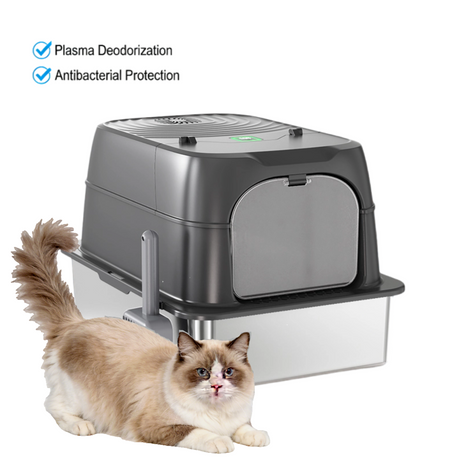
7. HAN-2825 at a glance
The Feature / Details table below is taken from our HAN-2825 product page and extended with the commercial terms published there.
| Feature | Details |
|---|---|
| Model | HAN-2825 |
| Deodorization | Advanced plasma technology — high-voltage ionisation decomposes ammonia and organic odour molecules at source |
| Sanitization | Antibacterial protection; ionic sterilisation on litter surface and inner walls |
| Design | Fully enclosed / extra large; anti-splashing; large-capacity waste drawer |
| Safety | Smart infrared anti-pinch sensors; cleaning cycle stops when a cat enters |
| Cleaning | Automatic self-cleaning with hands-free waste collection |
| Price / MOQ | US$120, MOQ 1,000 pcs (indicative wholesale terms — confirm with sales) |
| Supplier | Hanseek Tech, Shenzhen, China — OEM / ODM and private-label support |
Specifications as published on the product page. Verify certifications, dimensions, entry height, noise level and litter compatibility with our sales team before placing an order.
8. Three boxes, three different answers
Different cats, different homes, different placement problems. Here are three models from our litter box range, each on its own product page.
HAN-2825 Smart Automatic Cat Litter Box
A fully enclosed, extra-large self-cleaning box built for the placement advice above: plasma deodorization so the station can live indoors without the smell, antibacterial protection for a cleaner inner surface, anti-splashing containment, and infrared anti-pinch sensors that stop the cycle when a cat steps in. The high-capacity waste drawer keeps handling to a scheduled empty rather than a daily intervention.
Best for: indoor placement in living areas or bedrooms, multi-cat households, and retail / private-label ranges built around odour control and enclosed designs.
https://www.hanseektech.com/automatic-smart-cat-litter-box-fully-enclosed-extra-large-anti-splashing-electric-cat-toilet-auto-cleaning.htmlView HAN-2825 → Ask for wholesale terms
Does plasma deodorization use a filter that needs replacing?
It uses high-voltage ionisation to break down odour molecules at source rather than masking them with a filter or fragrance. Check the product page and our sales team for the current maintenance schedule and replaceable parts list.
Is the box safe if my cat walks in during cleaning?
The high-precision infrared sensor system stops the cleaning cycle when a cat enters, with an anti-pinch design. As with any automatic box, confirm your cat's weight range and supervise the first week of use.
Is US$120 the retail price and what is the MOQ?
US$120 is the indicative wholesale price published on the product page at MOQ 1,000 pcs. For OEM / ODM, packaging, colour and logo options, request a formal quotation from our sales team.
65L Automatic Smart Cat Litter Box
An extra-large, fully enclosed self-cleaning electric cat toilet with odour-proof construction, auto scooping and app control, listed for large cats, indoor cats and kittens. A straightforward option when capacity and remote monitoring are the priorities rather than deodorization technology.
Best for: large breeds and multi-cat homes that want app-based monitoring in an enclosed design.
https://www.hanseektech.com/Automatic-Smart-Cat-Litter-Box-65L-Extra-Large-Self-Cleaning-Electric-Cat-Toilet-Fully-Enclosed-Odor-Proof-Auto-Scooping-for-Large-Cats-Indoor-Cats-Kittens-pd129361238.htmlView 65L model →
Does an enclosed box suit every cat?
No. Some cats prefer an open pan. Check the entry height and interior space against the cat's size and mobility, and leave the top or door open during the first week so the cat can learn the new entrance.
Can one automatic box replace the N+1 rule?
No. In multi-cat homes, keep one box per cat plus one extra. An automatic unit can be one of those stations, but it should not be the only one.
Is this model available for private label?
Hanseek Tech supports OEM and ODM across its pet range, including packaging and logo application. Confirm MOQ and lead time for this specific model with our sales team.
Semi-Enclosed Stainless Steel Cat Litter Box
A non-stick, odour-resistant stainless steel pan with a high splash guard, large capacity and an easy-clean semi-enclosed form. No motor and no sensors — a simple low-tech station for cats that dislike enclosed automatic drums, and a practical spare tray for senior cats under the N+1 rule.
Best for: cats that refuse automatic boxes, senior cats needing a low-sided station, and buyers wanting a durable non-plastic option.
https://www.hanseektech.com/semi-enclosed-stainless-steel-cat-litter-box-odor-proof-anti-splash-pet-toilet-large-capacity-easy-clean-for-indoor-cats-kittens.htmlView stainless steel box →
Why choose stainless steel over plastic?
Stainless steel is non-stick, does not hold odours the way scratched plastic can, and is easy to wash out fully. It is a common answer when a cat rejects a box because of lingering smells.
Is a semi-enclosed box a good backup station?
Yes. The open top keeps ventilation and an easy exit while the high sides contain scatter. It works well as the extra low-barrier tray recommended for kittens and older cats.
Can I mix this with automatic boxes in one order?
Yes. Hanseek Tech specialises in mixed containers across pet categories, so manual trays and automatic units can ship together with one invoice. Ask our team for a combined quotation.
9. Reader Q&A
Where should I put a cat litter box?
A quiet, low-traffic indoor spot with a stable temperature, two clear escape routes and 24/7 access — away from food and water bowls and from appliances that start without warning. Spread boxes across rooms rather than lining them up.
Is a balcony a bad place for a litter box?
Usually. Temperature swings of 5–10°C, wind, noise, strong sun and constant laundry traffic all work against it. If there is no alternative, screen three sides, block direct sun and put a warm mat on the floor around the box in winter.
How far should a litter box be from food and water bowls?
At least 2–3 metres (6–10 ft), ideally in another room. A visual divider helps in small spaces.
Why is the washing machine the worst location?
Spin cycles start suddenly with vibration and low-frequency noise. Interrupted urination leaves urine in the bladder, which concentrates and can form crystals; in male cats a 3–4 mm urethra can block completely. Hallways add the same problem through constant foot traffic.
How many litter boxes do I need for two cats?
Three, following N+1, placed at least 1.5 m apart in different rooms. Three boxes in a row count as one location to a cat.
Are covered litter boxes bad for cats?
Not inherently. Check a low entry (around 10–12 cm, lower for seniors), an interior about 1.5× body length, ventilation, a removable top, and whether your cat actually accepts the enclosure. Some cats prefer an open pan.
What are the warning signs of a urinary blockage?
Repeated trips to the box, straining, drops of pink-tinged urine, crying, licking the genitals, vomiting, lethargy. A cat passing no urine needs a vet immediately; the window can be as short as 6–12 hours.
Can an automatic litter box prevent urinary problems?
No. It keeps the litter bed cleaner and makes an indoor station easier to live with, but placement, hydration, diet and veterinary care determine urinary health. Any change in frequency or output deserves a vet visit.
What should I look for in an enclosed self-cleaning litter box?
Entry height, interior space, how odour is handled, waste drawer capacity and the safety system. Insist on infrared or weight sensors with anti-pinch protection that stop the cycle when a cat enters. For wholesale buyers, also confirm MOQ, certifications and OEM options.
10. Final thoughts
People put a litter box on the balcony for good reasons: ventilation, smell, floor space. A cat does not understand any of them. It registers wind, cold tiles, a machine that starts without warning, and a curtain that moves when it is most vulnerable. So it holds on. And the bill for that decision is not measured in square metres.
Tonight, look at where your box actually sits. Is there a washing machine beside it? Does a draught come through? Is the food bowl half a metre away? If any of those are true, move it first. Then make sure the box itself gives the cat a low, roomy, well-ventilated place to go — and gives you a reason to keep it indoors. That second half is a design problem, and it is the one we work on.
Retailer, distributor or private-label brand looking for an enclosed self-cleaning box with real odour control? Send us your target market and quantity and we'll come back with specifications, MOQ and OEM options.
See the HAN-2825 → Request a wholesale quote
Hanseek Tech · sales@hanseektech.com · +86-755-28274716 / +86-13662266273


