
Views: 0 Author: Site Editor Publish Time: 2026-11-10 Origin: Site


Asia’s top ten pet food companies run from $190 million to $1.01 billion in annual revenue. Japan holds three of the ten slots, including first and second.
China’s two entries — Yantai China Pet Foods ($764M) and Gambol Pet Group ($720M) — both sit in the top five. Both started as contract manufacturers for other people’s brands.
The ranking is not really a story about size. It is three different bets: Japan on trust and narrow niches, Thailand on raw materials, China on domestic scale and speed.
Ask most people to name the biggest pet food company in Asia and they will reach for a brand they have seen in a supermarket aisle. The actual answer is a company most of them know for something else entirely.
That is the first sign this ranking is worth reading closely. The second is what the two Chinese entries have in common: neither of them was built as a brand. Both were built as factories.
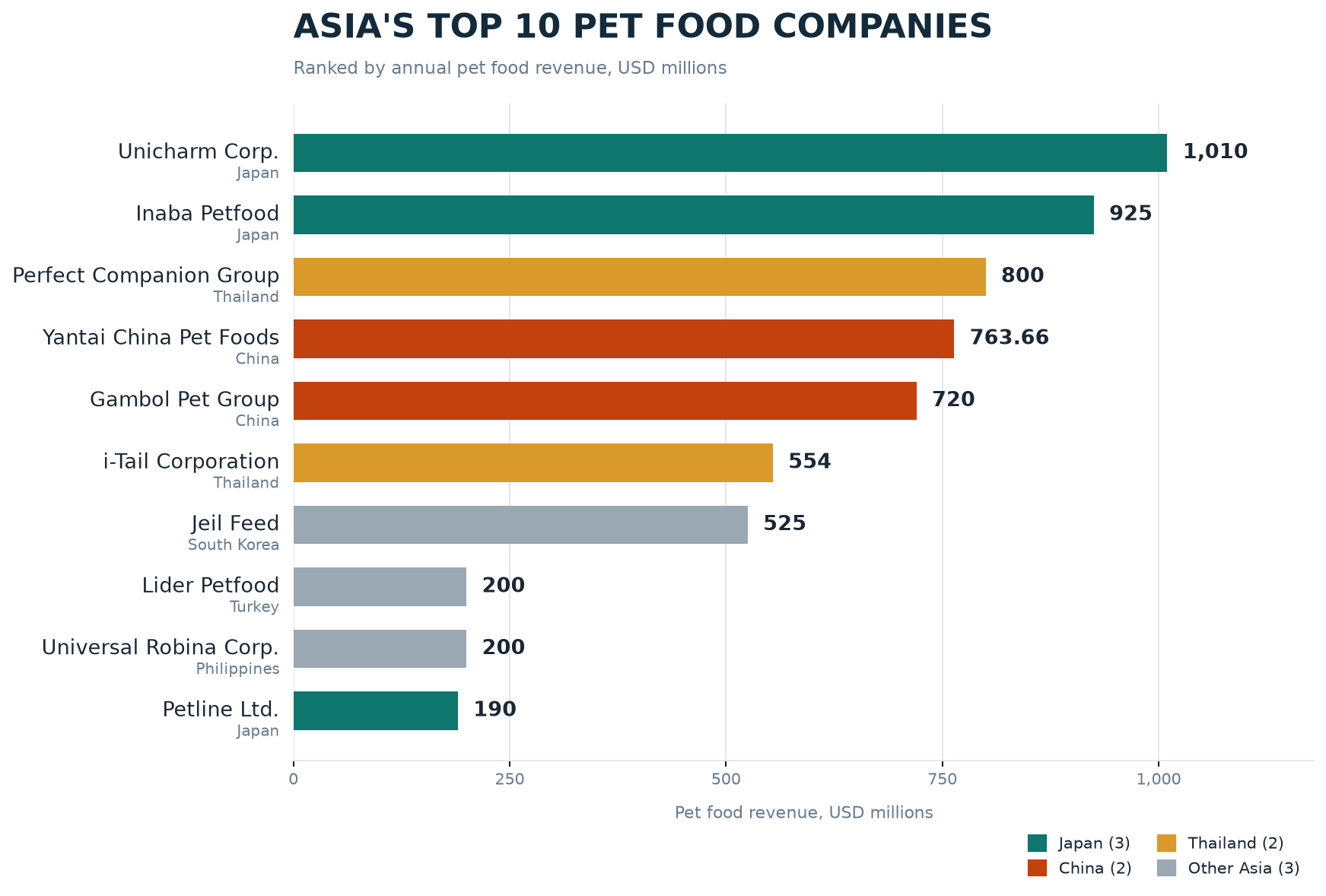
Asia’s ten largest pet food businesses by annual revenue. Japan holds three slots, China and Thailand two each. Source: 2026 top-companies dataset; figures in USD millions.
Unicharm sits at the top of the list with $1.01 billion in pet food revenue. In most of Asia, the company is known for diapers, baby care and hygiene products — not for cats.
That background is exactly why it won. Hygiene manufacturing demands things pet food also demands at scale: strict quality control, stable supply chains, disciplined retail distribution and a habit of managing shelf space rather than just factories. Unicharm pointed those capabilities at wet food through brands like Silver Spoon and Tsukino Hana, and built a position in Japan and East Asia that is extremely difficult to dislodge.
It is a useful reminder for anyone studying this market. The winner was not the most passionate pet company. It was the company with the best adjacent capability, applied to a category that rewards consistency more than novelty.
Inaba Petfood, at $925 million, has been making food since 1805. Two hundred and twenty years, most of them before the pet food industry existed in any recognisable form.
Its modern engine is a single insight: cats are fussy, and fussiness is a technical problem, not a marketing one. The CIAO line of lickable treats and wet food is engineered almost entirely around palatability — texture, moisture, aroma — and then iterated relentlessly. Walk into a Japanese pet store and the shelf reads like a product roadmap: cup, pouch, stick, topper, tuna, chicken, scallop.
Inaba is not winning on price. It is winning on the fact that a cat which refuses everything else will eat this. That is a moat built from formulation, not from capital.
Perfect Companion Group ($800 million) and i-Tail ($554 million) both sit in the top six, and both are downstream of the same resource: tuna.
Thailand processes enormous volumes of seafood, and the parts that do not go to human consumption become pet food inputs at a cost no inland manufacturer can match. That is why so many global brands quietly make their wet food and cans in Thai factories. Thailand is not just a supplier of pet food; it is the kitchen.
The weakness is on the other side of the ledger. Thai companies have built formidable OEM capacity and respectable own brands, but consumer recognition outside their home region remains thin. The industry’s own shorthand is blunt: strong kitchens, weaker labels.
Yantai China Pet Foods ($764 million) and Gambol Pet Group ($720 million) are fourth and fifth — the only country besides Japan with two companies in the top five.
Gambol’s 2025 revenue reached RMB 6.769 billion, up 29.06% year on year, with own brands contributing RMB 4.965 billion at a growth rate of 40.06%. That second number matters more than the first. For a company long associated with contract manufacturing, the growth engine has quietly become its own labels: Myfoodie at the mass end, Fregate pushing into high-meat, raw-style cat food, and a portfolio spanning several price tiers. Production sits in China, Thailand and New Zealand; products ship to Europe, the US, Japan and Korea.
Yantai took a different route. Revenue reached RMB 5.221 billion, up 16.95%, with three own brands — WANPY, Toptrees and ZEAL — layered on top of a contract manufacturing base that never went away. Its footprint is the most international of any company on this list: plants in China, the US, Canada, Mexico, New Zealand, Cambodia and the Netherlands, products in around 90 markets, and years of leading China’s pet food export volume.
Two paths, one origin. Both companies spent their first decade making other people’s products, learning quality systems and cost structure, and then converted that into brands once domestic demand was large enough to support the investment.
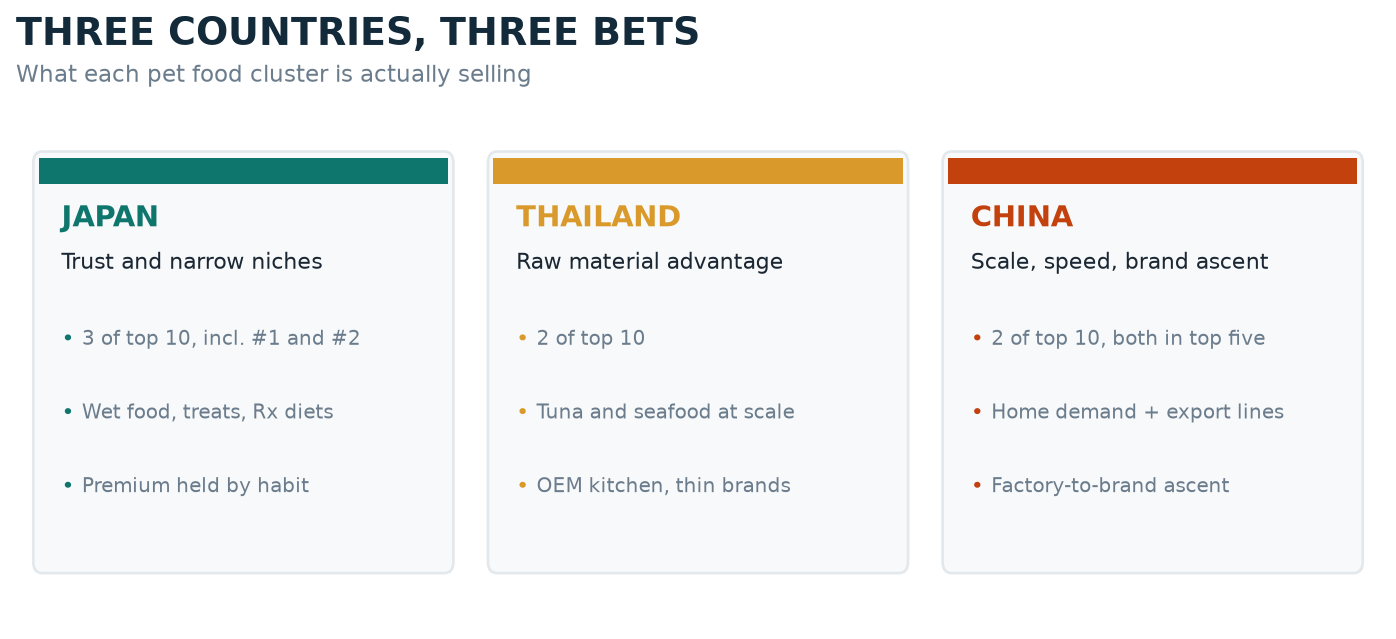
The same ranking, read by strategy rather than by revenue.
Put the three clusters side by side and the structure becomes obvious. Japan sells certainty — wet food, treats, prescription diets, categories where the buyer is anxious and the brand is the answer. Thailand sells inputs — tuna, seafood, canning capacity. China sells availability — enormous domestic demand, fast product cycles, and a supply chain that can move from sample to container in weeks.
None of these is automatically better. They simply fail in different ways. Japan struggles to grow outside its home region. Thailand struggles to charge a brand premium. China struggles to be trusted at the top of the market.
There is a reason this ranking is dominated by food companies rather than accessory makers: food is the one category pet owners cannot postpone.
In China, food has held more than half of all pet spending every year since 2021, rising from 51.5% to 53.7% by 2025. Supplies, medical and services all sit far below it. Even in weaker consumer years, the food share did not fall — it edged up.
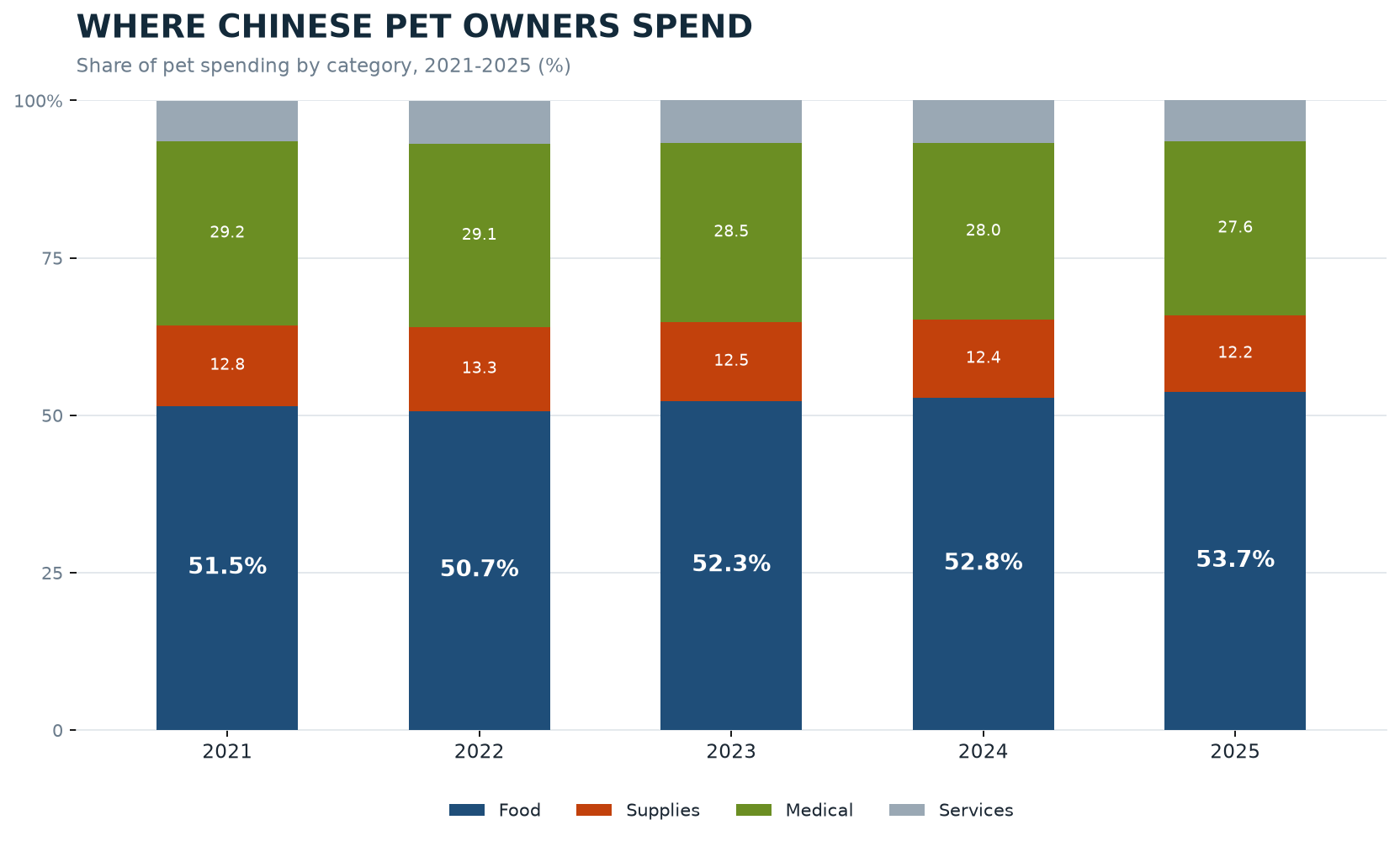
Food is the only category that has grown its share of Chinese pet spending over five years.
That is the base layer under every company on this list. A pet food business does not need a trend to sell; it needs a household with a cat in it. Accessories have seasons, medical has price sensitivity, services depend on location. Food renews itself every few weeks.
Revenue tells you who is big. It does not tell you who is gaining.
In 2025, pet food GMV across Tmall, JD and Douyin reached RMB 30.71 billion, up 10.2% — solid in a soft consumer environment. But the average hides the redistribution. Traditional e-commerce share drifted down while Douyin’s pet category grew 88% year on year.
Short video and live commerce lowered the cost of building a brand. A company no longer needs national retail distribution to reach a young pet owner; it needs a product that performs on camera and a reason to be talked about. That shift is the single biggest opening for Chinese brands against incumbents whose strength was built in physical stores.
It would be easy to read this list as China catching up. The revenue gap says otherwise. The top two Japanese companies are still roughly 20–30% larger than the leading Chinese entries, and the difference is not capacity — it is what consumers will pay for a name.
Japan’s moat is not factories. It is prescription diets for urinary and kidney conditions, wet food with a texture cats reliably accept, and twenty years of a vet recommending the same brand. That kind of trust is not bought with a production line, and it is not compressed into three years.
Chinese brands are moving in that direction — urinary care, weight management, senior nutrition — but the premium end is still held by incumbents, and domestic price competition is brutal enough to erode the margin needed to fund that move.
Stage one was capacity. For two decades, Chinese and Thai factories competed on cost, quality consistency and delivery. Win the order, keep the client, reinvest. Both Chinese entrants on this list were built in that stage.
Stage two is brand and narrow R&D. Not a broader catalogue — a sharper one. A product that solves one specific problem so well that the buyer stops comparing prices. This is where Japan has been living for years, and where the Chinese leaders are now investing.
Stage three is still forming. It looks less like a product fight and more like a data and channel fight: who owns the relationship with the pet owner, who learns fastest from it, and who can turn that learning into the next formulation.
If you buy pet products from Asian manufacturers — food or otherwise — this ranking changes the questions worth asking.
What share of revenue is own brand versus contract? A supplier with a real own-brand business has learned to say no to bad briefs. That usually shows up in product quality.
Which single problem does this product solve? The companies that climbed this list did it with narrow, defensible products, not wide catalogues.
Do you have the regulatory dossier ready for my market? Food and functional products live or die on documentation. Ask before the sample, not after.
Can you iterate a formulation in 90 days? Palatability is an engineering loop, not a one-time spec.
Where is the factory, and where is the input? Thailand’s cost advantage comes from the fish, not the building. Location of the plant tells you less than location of the raw material.
The pattern that built the top ten is the same one that matters at the sourcing desk: specialists with a real capability beat generalists with a big catalogue. That logic applies to pet supplies just as much as it does to food.
Unicharm of Japan, with about $1.01 billion in annual pet food revenue, ahead of Inaba Petfood at $925 million. Unicharm is better known for hygiene and baby care products; it built its pet food position on wet food brands such as Silver Spoon and Tsukino Hana.
Yantai China Pet Foods reported $763.66 million and Gambol Pet Group $720 million in pet food revenue, ranking fourth and fifth in Asia. In RMB terms, Gambol reached RMB 6.769 billion in 2025 and Yantai RMB 5.221 billion.
Access to cheap, abundant seafood inputs — particularly tuna — plus large-scale canning and wet food capacity. Many global brands manufacture there. Thai companies have strong OEM operations but weaker brand recognition in overseas consumer markets.
Yes, by a wide margin. In China, food accounted for 53.7% of pet spending in 2025, up from 51.5% in 2021, while supplies, medical and services all remained far smaller. Food is the category owners cut last.
Japan leads on narrow, high-trust categories such as wet food, palatability-driven treats and prescription diets, built over decades. Chinese brands lead on domestic scale, speed of iteration and online channel execution, and are now moving into functional and premium segments.
Own-brand versus contract revenue share, the specific problem the product solves, export documentation for your market, formulation iteration speed, and whether the raw material advantage is real or only the factory location. Ask for the regulatory dossier before requesting samples.
Hanseek Tech supplies pet products from China to distributors and marketplace sellers, with category focus on litter boxes, beds and enrichment. If you are shortlisting suppliers for 2026, start a conversation here.


