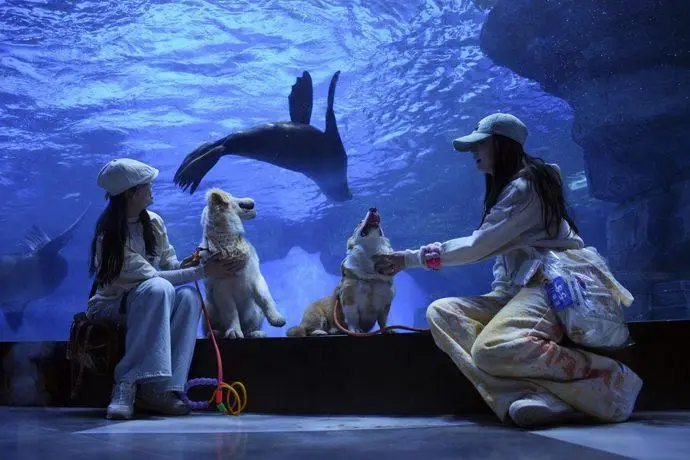
On January 13, the 2026 Peking University Report, compiled under the guidance of the National Art Terminology Review Committee and the China Cultural Industry Management Professional Committee, and chaired by Professor Xiang Yong, Dean of the Institute of Cultural Industries at Peking University, was released in Beijing. The report sorted out the top 10 buzzwords and characteristics of the cultural industry in 2025, and accurately predicted the top 10 development trends for 2026. Among them, the warm upgrading of the integration of pet economy and cultural tourism has emerged as a highly anticipated emerging trend, empowered by emotional value and scenario-based innovation potential, injecting new growth momentum into the cultural industry.
I. Comprehensive Interpretation of the Top 10 Trends in the Cultural Industry for 2026
1. Continuous Deepening of Digital Governance for Cultural Resources
The digitalization of intangible cultural heritage (ICH) and cultural relic resources has entered a new stage of standardization and efficiency. Based on a unified standard system, precise archiving has been completed, and technologies such as AI and 3D modeling have greatly improved the accuracy of resource collection and the efficiency of cultural relic restoration. The interconnection of digital resource libraries is accelerating, breaking data barriers through sharing platforms, expanding communication boundaries by integrating user co-creation models and multilingual adaptation capabilities, and achieving a strategic transformation from static protection to dynamic inheritance, and from single-point storage to global sharing, enabling cultural resources to thrive in the digital era.
2. AI Agents Empower the Rise of Cultural Tourism Super Individuals
AI agents are deeply integrated into the entire chain of cultural tourism content creation and operation. By lowering the threshold for professional creation and operation, they continuously empower groups such as rural cultural tourism internet celebrities, representative inheritors of ICH, and niche cultural tourism bloggers to grow into "cultural tourism super individuals". Supported by professional entrepreneurship service platforms, individuals can realize the coordinated promotion of content creation, multi-channel communication, and commercial transformation, driving the innovation model of the cultural tourism industry to shift from resource-dependent to capability-empowered, and activating the innovation vitality of individuals.
3. Global Translation of Local Culture Drives the Upgrading of Cultural Going Global
Represented by phenomenal works such as Li Ziqi’s pastoral videos, Tang Palace Night Banquet, and Black Myth: Wukong, China’s cultural going global has entered a stage of paradigm innovation. By extracting the core cultural genes of local resources such as ICH, folk customs, and traditional aesthetics, and transforming them into perceptible, interactive, and resonant narrative content, it effectively reduces the "cultural discount" while retaining the unique cultural heritage, realizing the upgrading from single product export to cultural value communication, and building a new path for the global expression of Chinese culture.
4. Policy-Market Dual Drive Lays a Solid Foundation for Development in the 15th Five-Year Plan Period
With the advancement of the 15th Five-Year Plan, China’s cultural industry has entered a critical stage of deep integration and coordinated development driven by policy support and market vitality. Macro policies will provide solid support in strategic layout, resource allocation, and the construction of international communication systems, delineating the direction and building the framework for industrial development; meanwhile, market mechanisms will continue to stimulate innovation momentum and consumption potential, promoting the high-quality development of the cultural industry through positive interaction between supply and demand sides.
5. Cultural Data Elements Drive Brand Development
Cultural data elements have evolved from auxiliary tools to the core engine driving the brand development of the industry. By deeply mining user behavior data, activating the value of cultural resource data, and innovating the supply of digital cultural and creative products and services, cultural brands are gradually breaking away from reliance on single resources and transitioning to a "data-driven" model. Data empowerment enables brands to accurately match consumer demand, optimize product iteration logic, and achieve continuous improvement of brand value and significant enhancement of market competitiveness.
6. Intelligent Robots Are Widely Applied in the Cultural Industry and Tourism
Intelligent robots are fully integrated into all scenarios of scenic spot management, tourist services, and cultural performances, ranging from multilingual intelligent tour guides and unmanned hotel services to real-scene interactive performances and intelligent ticketing management, realizing the full-chain upgrading of cultural tourism services. This trend not only effectively alleviates the labor shortage caused by population aging, but also creates immersive interactive experiences beyond reality for consumers through the integration of technology and humanities, marking the official transition of smart cultural tourism from "digitalization" to a new stage of "in-depth intelligence".
7. Cultural Tourism + Multiple Industries Spawn New Formats and Scenarios
During the 15th Five-Year Plan period, the cross-border integration of "cultural tourism +" will extend to deeper levels and broader fields, spawning diverse new formats such as immersive cultural tourism experiences, digital cultural museums, low-altitude tourism, wellness tourism, and study tours. Technology empowerment, ecological integration, and industrial linkage have become the core driving forces, promoting the upgrading of cultural tourism scenarios from traditional sightseeing to experiential, digital, and personalized, breaking industry boundaries and forming new consumption growth points and industrial growth poles.
8. Warm Upgrading of the Integration of Pet Economy and Cultural Tourism (Core Trend)
As one of the warmest trends in 2026, the integration of the pet economy and the cultural tourism industry is accelerating its rise and becoming a new outlet for cultural consumption. Centered on the emotional consumption and companionship needs of pet owners, this integration has spawned characteristic formats such as pet-friendly hotels, themed travel routes, pet-friendly outdoor activities, and human-pet social spaces, realizing the upgrading from "human-centered" cultural tourism to "human-pet symbiotic" cultural tourism.
In terms of market practice, this trend has shown vigorous vitality: Qinhuangdao launched pet-friendly sailing projects, receiving more than 1,000 pet-owning customer groups and directly driving over 20 million yuan in consumption; Shanghai opened the first pet-friendly customized bus line, equipped with professional training safety personnel, with an occupancy rate of over 70%; pet-friendly business districts and indoor theme parks have emerged in many places, providing one-stop services such as pet boarding, grooming, and socializing, with the annual turnover of some theme parks reaching millions of yuan, a significant increase compared with traditional pet industry formats. This "warm upgrading" not only deepens the segmented market of cultural tourism services, but also builds a highly sticky new consumption scenario by meeting the common emotional needs of humans and pets, which is in line with the core trend of "emotional value consumption" at present.
9. Scenario Cultivation Accelerates the Implementation of Cultural Innovation
Cultural innovation has entered a critical stage of scenario-based implementation from conceptual exploration. Night markets, immersive theaters, cultural and creative blocks, and rural cultural stations have become "innovation incubators" integrating art, technology, commerce, and social interaction. Through the design of highly interactive and immersive scenarios, it activates the participation enthusiasm of young consumer groups, promotes the evolution of cultural and creative products from single commodities to carriers of lifestyle, and reshapes the new cultural consumption ecology in urban and rural areas.
10. Agentic AI Drives the Innovation of Cultural Products and Models
Agentic AI reshapes the creation and operation logic of cultural products with its capabilities of autonomous planning, resource allocation, and full-process execution. AI agents can independently complete the entire chain of tasks such as content planning, material integration, product generation, and channel distribution, realizing efficient transformation of "demand input equals finished product output". The industrial model will shift from human-led to human-machine collaboration, spawning new formats such as intelligent brokerage, automated IP development, and personalized content customization, accelerating product iteration speed and accurately responding to fragmented and instant consumption needs.
II. Top 10 Buzzwords and Characteristics of the Cultural Industry in 2025
Top 10 Buzzwords
Digital Intelligence Empowerment, Micro-short Dramas/New Mass Art and Literature, AIGC Content Compliance, Emotional Value Consumption, Immersive Entertainment, Low-altitude Economy + Cultural Tourism, Cultural Going Global 2.0, Integration of Culture, Commerce, Tourism and Sports, Embodied Intelligence, Jiangsu Football Super League.
Top 10 Characteristics
Emotional economy dominates the new logic of cultural consumption; Guochao culture continues to rise; Scenario-driven new models of cultural consumption; AI deeply empowers the entire chain of the cultural industry; AIGC reconstructs the digital content ecosystem; Cross-border integration of cultural IP catalyzes new consumption formats; Culture empowers urban renewal/rural revitalization value reconstruction; Cultural going global realizes the upgrading from product export to model and platform output; Large language models activate the core of cultural resource activation and innovation; Digital intelligence expands new models for the development of the cultural industry.
III. Trend Summary and Outlook
The cultural industry in 2026 will revolve around the three core pillars of digital intelligence empowerment, cross-border integration, and value upgrading. The in-depth penetration of AI technology and the cross-border innovation of diverse formats will become the main growth drivers. Among them, the integration trend of "pet + cultural tourism" accurately meets the needs of emotional economy and personalized consumption by virtue of emotional resonance and scenario-based innovation, and is expected to become an explosive growth point in the next few years. For industry practitioners, grasping the value of data elements, deeply cultivating the needs of segmented scenarios, and balancing technology empowerment with humanistic warmth will be the key to seizing market opportunities.


